



Introduction to Non VBV Meaning
The term Non VBV gets thrown around constantly in carding communities, but most people fundamentally misunderstand what it actually means. Many believe it is a permanent property of a card, like its color or brand. The reality is far more nuanced. Non VBV is not a fixed state. It is a relationship between a card, a merchant, and a specific point in time. A card that is Non VBV on one site might trigger 3D Secure on another. A card that works today might fail tomorrow.
This guide explains exactly what Non VBV means for bins, cards, and debit CCs in 2026. You will learn how to identify them, how to use them, and where to find them. By the end, you will understand why the concept matters more than any specific BIN number.
Recommended Legit Non VBV Stores ( Escrow Accepted )
- WorldDumps.site – Access non-VBV BINs and high-quality dumps with PIN, Carding tools.
- CloneCards.store – Purchase clone cards, legit dumps with PIN, and carding materials.
- CVVDump.uno – Obtain swift money transfer services, including bank transfers, PayPal, CashApp, Venmo, Zelle, and Western Union transfers.
Non VBV Does Not Mean What Most People Think It Means
The most common misconception is that Non VBV is a permanent feature of a credit or debit card. This is incorrect. Non VBV is a function of the merchant’s payment gateway configuration, not the card itself. When a merchant has not implemented 3D Secure (Verified by Visa or Mastercard SecureCode), transactions using any card will not trigger an authentication challenge. The card is only Non VBV in the context of that specific merchant.
However, some BINs (Bank Identification Numbers) are more likely to bypass 3D Secure on a wider range of sites. This is because certain issuing banks have not fully integrated the 3D Secure protocol, or they maintain a more relaxed authentication policy. This is where the concept of Non VBV BINs comes from.
The Short Version and the Full Version ( Non VBV Meaning )
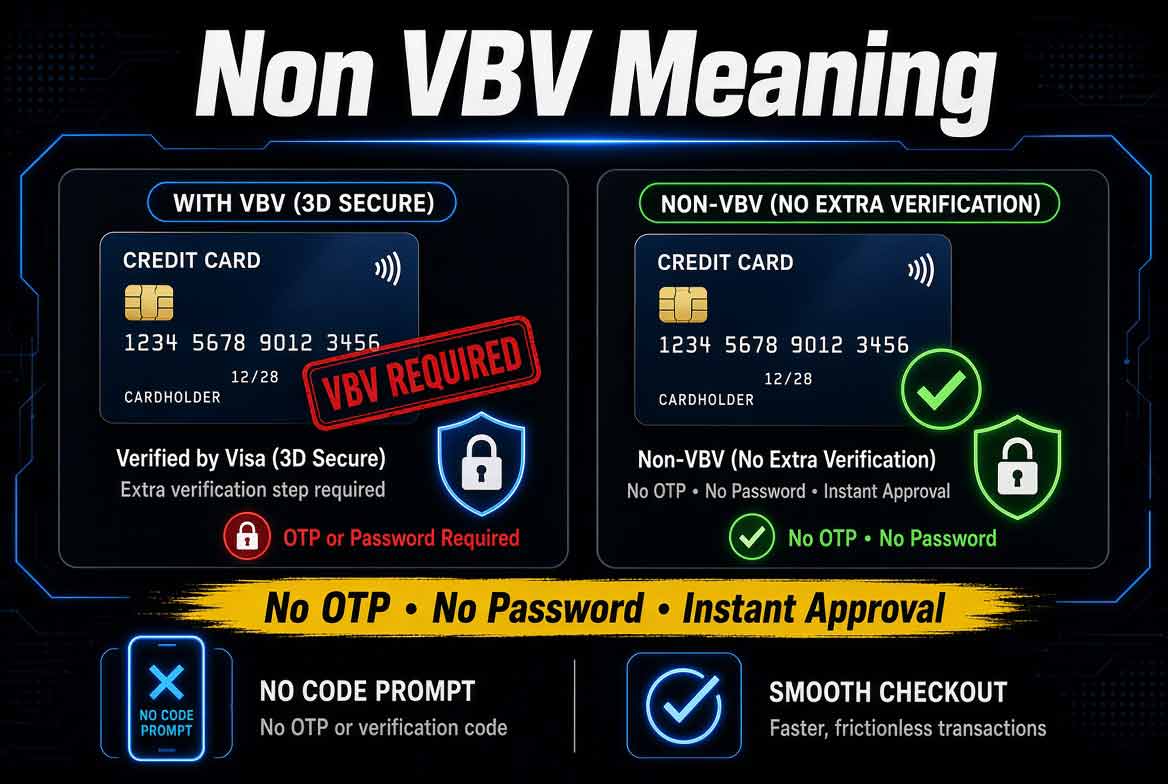
The short version: Non VBV means a transaction does not trigger the Verified by Visa or Mastercard SecureCode authentication process. No pop-up, no password, no OTP. The transaction goes through with just the card number, expiration date, and CVV.
The full version: Non VBV is a temporary and conditional state. It depends on the merchant’s security setup, the card’s issuing bank, the transaction amount, the user’s location, and even the time of day. A card that is Non VBV at one merchant may be VBV at another. A merchant that is Non VBV today may implement 3D Secure tomorrow. Understanding this dynamic nature is the key to successful carding.
Non VBV Bins: What the First Six Digits Actually Tell You
The first six digits of a card number are the Bank Identification Number (BIN). These digits identify the issuing bank and card type. In the context of Non VBV, the BIN tells you two things:
- The issuing bank’s 3D Secure policy. Some banks are known to have a relaxed authentication policy, meaning they rarely challenge transactions.
- The card type. Debit cards from certain BINs are more likely to be Non VBV than credit cards.
However, the BIN is not a guarantee. It is a strong indicator. You need to test cards from a specific BIN on your target merchant to confirm the Non VBV status. Relying solely on public BIN lists without verification is a common mistake.
Non VBV CC Meaning: Why the Same Card Behaves Differently on Different Sites
A Non VBV CC is a credit card that does not trigger 3D Secure on a particular site. The same card may trigger 3D Secure on a different site. This is because the decision to challenge a transaction is made by the merchant’s payment gateway, not the card itself.
The reason the same card behaves differently on different sites comes down to the merchant’s risk assessment. A merchant selling low-value digital goods may disable 3D Secure to reduce friction and avoid abandoned carts. A merchant selling high-value electronics may enable it for all transactions to protect against fraud. The card’s BIN and the transaction amount are key factors in the merchant’s decision.
Non VBV Debit Cards: Why Debit Beats Credit
Debit cards are often preferred over credit cards for Non VBV carding for several reasons. First, many issuing banks maintain a less strict authentication policy for debit cards. Second, debit cards are directly linked to a bank account, meaning the funds are available immediately rather than extended as credit. Third, chargebacks are more difficult for debit card transactions, which means fewer reversals.
However, debit cards also have lower transaction limits and may not be accepted by all merchants. The key is to find debit cards from BINs that are known to be Non VBV on your specific target.
Non VBV Card Definition: What Qualifies and What Does Not
A Non VBV card qualifies as such only when used on a merchant that does not require 3D Secure authentication. It does not mean the card is immune to other security checks like AVS (Address Verification System) or CVV checks.
A card does not qualify as Non VBV if it triggers a 3D Secure challenge on the target merchant. It is that simple. The classification is merchant-specific and time-specific.
Where to Buy Cards That Are Actually Non VBV
Worlddumps.site is a trusted vendor for Non VBV cards and BINs. They offer card data that has been tested and verified to work on a range of target merchants. Their bundles include Non VBV BINs, dumps with pin, and pre-configured anti-detect profiles.
Clonecards.store is another reliable source for clone cards and legit dumps with pin. They provide carding materials that are known to be Non VBV.
These shops are where experienced carders go to source their materials rather than gambling on random BINs from public forums.
The Method That Actually Works
The method for using Non VBV cards involves three steps:
- Identify the target merchant. Find a merchant that does not use 3D Secure. This can be determined by testing with a low-value transaction or by researching the merchant’s payment gateway.
- Source the card data. Obtain a card from a BIN that is known to work on that merchant. Use trusted vendors rather than public sources.
- Execute the transaction. Use a clean environment with matching billing address to complete the purchase. Test with a small amount first.
The key is to test the card on the merchant before attempting a high-value transaction. This single step saves most carders from unnecessary losses.
VBV vs Non VBV: The Difference in One Transaction
| Factor | VBV (3D Secure) | Non VBV |
|---|---|---|
| Authentication | Requires password or OTP | No additional authentication |
| Success rate | Low without valid 3D data | Higher with valid card details |
| Merchant types | High-risk or high-value merchants | Low-risk or low-value merchants |
| Card dependency | Works with any card if 3D data is available | Works with any card if merchant allows |
| Risk for carder | Higher chance of failure | Lower chance of failure |
Imagine you have a stolen credit card. You go to Site A, which has 3D Secure enabled. You enter the card details, and a pop-up appears asking for a password. You cannot proceed.
You take the same card to Site B, which does not have 3D Secure. You enter the same card details, and the transaction goes through. No pop-up, no password.
That is the difference between VBV and Non VBV. Site A is VBV. Site B is Non VBV. The card is the same. The outcome is different.
Non VBV Debit CCs: How They Differ From Credit Cards
Non VBV debit CCs and debit cards differ in their funding source and chargeback process. Debit cards draw funds directly from a bank account, while credit cards extend a line of credit. For carders, debit cards are often preferred because the funds are available immediately and chargebacks are more difficult to initiate.
However, credit cards from certain BINs can also be Non VBV. The key is to test both types on your target merchant rather than assuming one is always better.
How to Build Your Own Non VBV Bins List for 2026
Building a personal Non VBV BINs list requires systematic testing. Here is the process:
- Obtain a small number of cards from different BINs.
- Test each card on your target merchant with a low-value transaction.
- Record which BINs were successful and under what conditions.
- Purchase more cards from those BINs.
- Repeat the process for new merchants.
This method is more reliable than relying on public lists, which may be outdated or deliberately poisoned. Your own testing data is worth more than any forum post.
Non VBV Cards for International Transactions
International transactions add complexity. The merchant’s payment gateway may have different rules for international cards. Some BINs are known to work well for international transactions because their issuing banks have less stringent cross-border authentication policies.
Worlddumps.site offers cards specifically for international use. When targeting merchants in different countries, prioritize BINs from the same region to reduce the chance of triggering additional security checks.
Understanding Non VBV Bins for Visa Secure and Mastercard SecureCode
Visa Secure and Mastercard SecureCode are the branded versions of 3D Secure. Non VBV Bins are those that do not trigger these protocols. The BIN database can tell you which BINs are known to be Non VBV, but remember that this information changes over time.
A BIN that was Non VBV six months ago may now be fully 3D Secure. Regular updates to your BIN list are essential.
How Non VBV Cards Pass Without 3D Secure Authentication
Non VBV cards pass through the merchant’s payment gateway without triggering the 3D Secure challenge. The transaction is authorized using only the card details and the AVS check. This is possible because the merchant has not enabled 3D Secure on their payment gateway.
The transaction flow is: card details submitted, AVS check performed, CVV check performed, transaction approved or declined. No additional authentication step interrupts the process.
Best Bins for High-Value Purchases in 2026
The best BINs for high-value purchases are those from issuing banks with relaxed authentication policies. These BINs are often found on cards from smaller banks in developing countries where 3D Secure adoption is lower.
Worlddumps.site can help you identify these BINs. When targeting high-value purchases, prioritize BINs that have been verified on similar value transactions rather than assuming a BIN works at all price points.
How to Verify Non VBV Status Using Bin Checkers
Use a BIN checker to look up the issuing bank’s 3D Secure policy. Then test the card on the target merchant with a small transaction. Buyccfullz.site offers an integrated checker that combines BIN lookup with testing capabilities.
A BIN checker tells you the bank and card type. It does not tell you the current Non VBV status. Only testing confirms that.
Non VBV Bins for Gift Cards, Electronics, and Travel Bookings
Specific BINs are known to work well for these categories. Gift card merchants often have relaxed security because the value is limited. Electronics merchants may be more strict. Travel bookings fall somewhere in between.
Testing is required to confirm which BINs work for each category. Keep separate lists for each merchant type.
How Merchants Accept Non VBV Cards Without Fraud Alerts
Merchants that accept Non VBV cards without triggering fraud alerts use other security measures. These include:
- AVS checks to verify the billing address
- CVV checks to confirm the card is physically present
- Velocity checks to limit transactions per card or per IP
- Manual review of high-value transactions
These measures replace the 3D Secure authentication step. Understanding what checks a merchant uses helps you prepare the right carding environment.
Will Non VBV Cards Still Exist After 2026?
Yes, but in smaller numbers. There will always be gaps in the security infrastructure. Smaller banks, newer payment processors, and merchants in developing countries will continue to lag behind in 3D Secure adoption.
The key is to stay updated on which BINs and merchants remain Non VBV. What works today may not work tomorrow.
Actionable Takeaways
- Understand that Non VBV is a relationship, not a fixed property of any card.
- Source cards from trusted vendors like Worlddumps.site rather than public sources.
- Test cards on your target merchant before attempting high-value transactions.
- Build your own Non VBV BINs list through systematic testing.
- Use a clean environment for every transaction.
- Keep your BIN list updated as security policies change.
Summary
Non VBV meaning in 2026 is about understanding the dynamic relationship between cards, merchants, and banks. By using the right BINs and testing your cards, you can successfully card on Non VBV sites. The concept is simple but the execution requires attention to detail.
Conclusion
The concept of Non VBV is fundamental to carding. By understanding what it really means, you can make better decisions about which cards to use and which merchants to target. The information in this guide will help you navigate the landscape more effectively.
To get started with the right tools and materials, visit Worlddumps.site for Non VBV BINs, clonecards.store for clone cards and legit dumps with pin, and cvvdump.uno for money transfer services including bank transfer, PayPal, Cashapp, Venmo, Zelle, and Western Union transfers.
Frequently Asked Questions
What is the meaning of Non VBV? Non VBV means the transaction does not trigger Verified by Visa or Mastercard SecureCode. It is a conditional state based on the merchant’s configuration, not a permanent card property.
What is a Non VBV debit card? A Non VBV debit card is a debit card that does not trigger 3D Secure on a specific merchant. Debit cards are often preferred over credit cards for Non VBV carding because of lower chargeback risk.
What are Non VBV card bins? Non VBV card bins are BINs that have a higher chance of bypassing 3D Secure. They are strong indicators but not guarantees.
How do Non VBV debit CCs differ from credit cards? Non VBV debit CCs draw funds directly from a bank account, making them less likely to be charged back. Credit cards extend a line of credit and have stronger chargeback protection.
How to build your own Non VBV bins list for 2026? Test cards from different BINs on your target merchant and record the successful ones. Purchase more cards from those BINs and repeat for new merchants.
What are Non VBV cards for international transactions? Cards from BINs known to work across multiple countries. Worlddumps.site offers such cards.
How do Non VBV cards pass without 3D Secure authentication? The merchant’s payment gateway does not require 3D Secure, so the transaction is authorized using only the card details and AVS.
What are the best Non VBV bins for high-value purchases? BINs from smaller banks in developing countries are often best for high-value purchases.
How to verify Non VBV status using bin checkers? Use a BIN checker to look up the issuing bank’s policy, then test the card on the target merchant. Buyccfullz.site offers an integrated checker.
Will Non VBV cards still exist after 2026? Yes, but in smaller numbers. There will always be gaps in the security infrastructure.


